
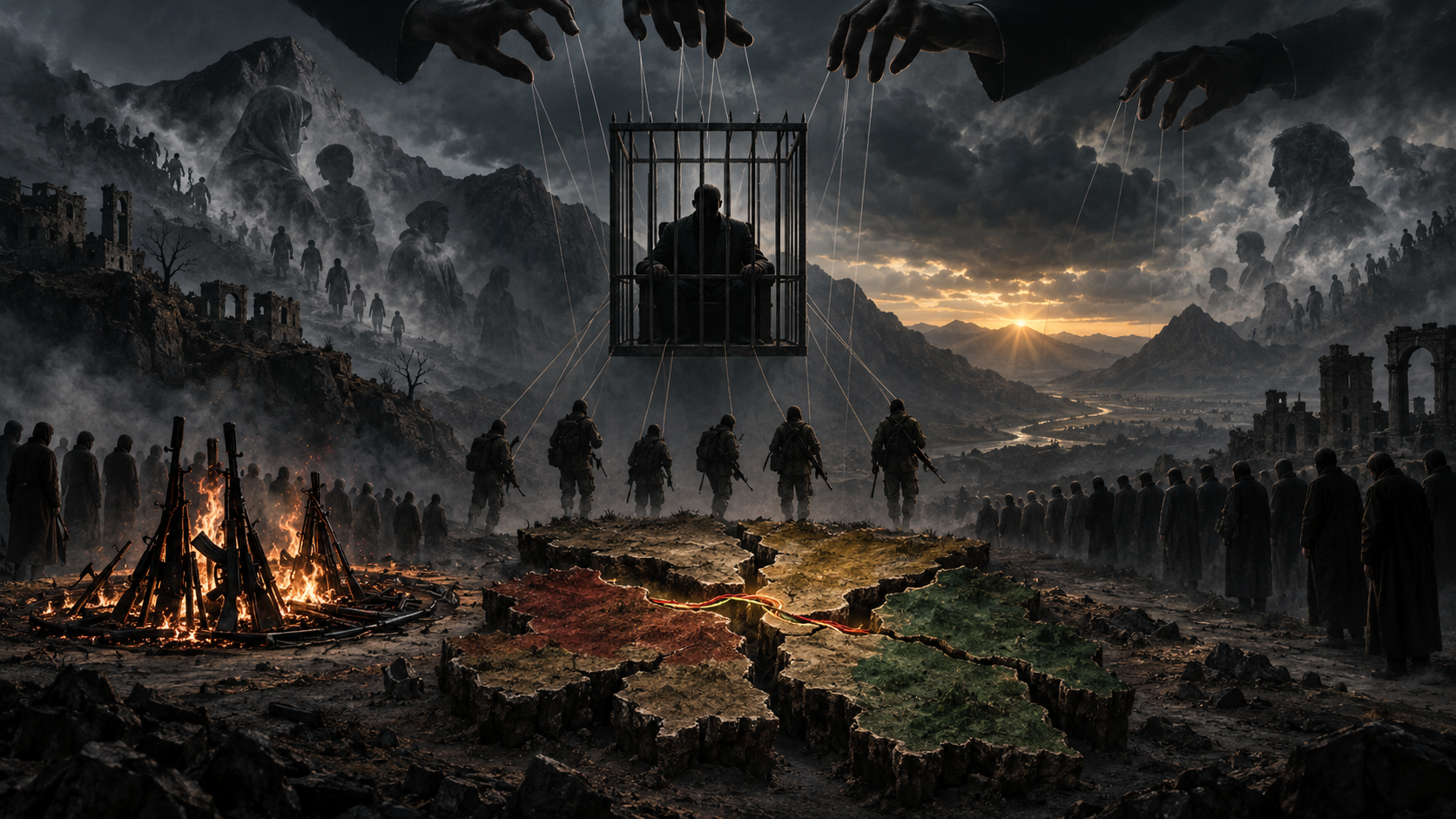
Apoism’s present-day attempt to hand the entire Kurdish struggle over to its enemies under a single umbrella lays bare the long-standing policy of erasing Kurdistan devised by the occupying states in Kurdistan.
The scenario I envisage is this: the states of the region and the international intelligence agencies operating freely within them came together seeking to recruit and cultivate a leader. They provided this person with every necessary opportunity as well as a source of weapons, saying, “Let us create a front organisation through the occupiers’ own hands.” They then opened branches of this organisation in the other occupying countries, creating the impression that it was genuinely Kurdistani. When the second thirty-year period began, they handed the leader they had created to the most powerful of the occupiers while ensuring that he retained his status as leader.
What did this achieve? A people whose leader is held captive by the enemy are themselves entirely captive. Their leader can no longer speak of his own free will; he speaks only when the enemy permits it, and the state decides what he will say. This allows the enemy to make the seemingly captive leader say whatever it wants and, whenever needed, to put him to work on domestic affairs, directly against the Kurds, or in the service of the government. There are so many examples of this that I could cite thousands.
The enemy has this captive leader write books and tales. Through these books, it makes the whole movement and the new generations admire him. Then one day it declares, “I will sit down with your leader and make peace; you must lay down your weapons.” The organisation, which for years has not even wiped the dust from its weapons, cheerfully stages theatrical ceremonies in which those weapons are burned.
But even that is not enough. Would victory in only one arena ever satisfy the occupiers? Never. They come out and say: “In Syria, too, you have oil, soldiers, armed forces, a democratic space, and Rojava. You will dissolve all of this and pledge allegiance to the remnants of ISIS who slaughtered thousands of your people years ago.” And who smiles, celebrates, says yes to this demand, and signs while Alawites are being massacred elsewhere in Syria? Of course, it is the “Mazlum child”—the captive leader’s so-called spiritual son, whose qualifications for the rank of general remain unknown.
Is this a coincidence? Do you truly believe that all of this could happen without the control and planning of the occupiers and the enemies?
Do not be naïve. Nothing in the Middle East happens without a plan. Those who have states make the plans in the Middle East: the Arabs, Persians, and Turks who have colonised the Kurds for centuries. Who, then, has no say? The cowardly generals who, despite commanding hundreds of thousands of soldiers, hand an undefended country over to the remnants of ISIS have no say. Organisations held captive, whose every breath requires the enemy state’s permission, have no say. Nor can people determine or attain anything when, instead of relying on what they themselves believe, know, research, and debate, they submit to a culture of obedience and feudalism and believe whoever is continually praised and feared.
The same things happened a century ago. When the leaders of the time were offered a Kingdom of Kurdistan, Kurdish leaders who understood nothing beyond playing at petty principalities with a feudal mentality chose instead to become governors of the murderous Turkish state. Today, likewise, so-called generals who possess the strength to bring all of Syria—and even Southern Kurdistan—to heel, and who could overthrow the murderous Iranian state through cooperation in Rojhilat, have chosen to become deputy ministers and advisers to the remnants of ISIS.
Nothing comes to mind except to say, “Shame on them.” I do not even feel like spitting in their faces. I do not want to curse them, hear them, or see them. Yet because I dream of having a Kurdistan and strive for it, I am affected by what is happening—by Apoism and its servants handing people like me, who dream of Kurdistan, over to our enemies.
What they are destroying today is not merely the Kurdistan of my dreams. They are destroying the dreams of the 27,000 martyrs whose number they themselves have proclaimed for years, as well as the dreams of those who were tortured, shot unjustly, marginalised, and burned.
Apoism has handed the enemies a tremendous victory. Unless a miracle occurs, we Kurds have suffered a great defeat in this century…