
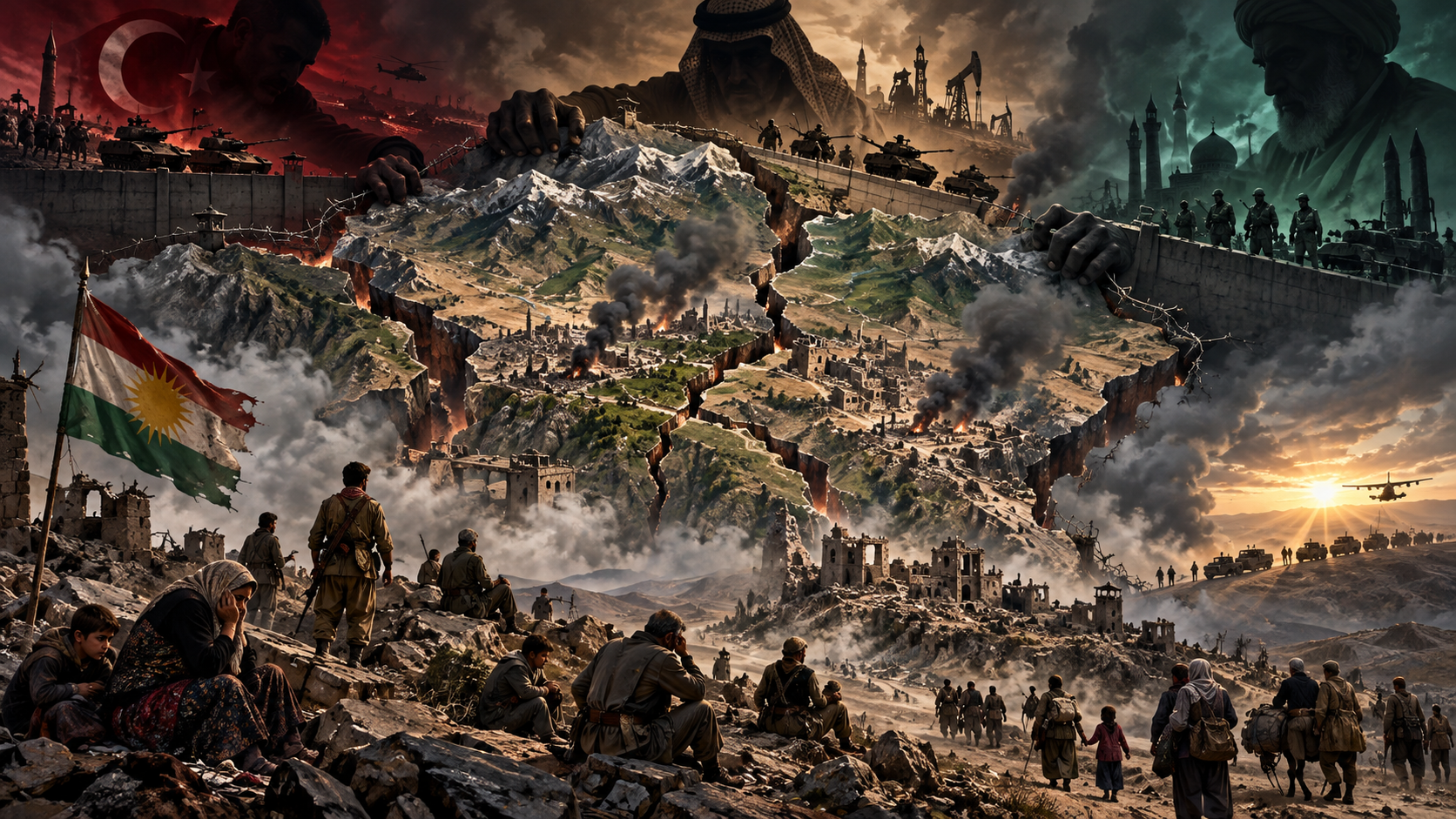
A large part of what has been happening in Kurdish geography in recent times stems from the passive and fragmented structure of the Kurds. At the same time, being left uneducated, being distanced from their own history, and being condemned to live in the lands they inhabit without language, without culture, in poverty and almost like slaves are also among the fundamental causes of the current situation.
Of course, the pressure imposed on the Kurds for centuries by colonialist states and the games they have played are also an important part of this picture. In addition, the existence of hundreds of traitors embedded among the Kurds, appearing to be Kurdish while serving colonialist states and their objectives under the guise of leaders, is also a reality.
Particularly striking is the fact that, in the war being waged against Iran, the Kurds have remained completely passive and have taken no initiative in this war despite the opportunities provided to them by America. On the contrary, they continue to stand by Iran despite being bombed by Iran; they remain silent while the Rojava administration is being brought down by ISIS gangs and Kurdish formations are being taken away from them one by one; instead of uniting among themselves and doing something, they constantly look to the outside world for help; they align themselves with the murderous Turkish state in order to avoid appearing alongside Israel; and the PKK and its leaders suddenly show an eagerness to transform into communes that demand nothing from Kurdistan, for which they say thousands of martyrs were sacrificed. All of this has caused the Kurds to be divided once again today by their colonialists.
Today, the Iraqi government's central authority has largely been restored, and American forces have withdrawn from the region without leaving even a single pebble behind in Kurdistan. In my view, this withdrawal is nothing other than handing the Kurds over to the Iraqi administration. However, I certainly do not believe that the United States is the party that should be blamed here.
For 23 years, the United States provided the Kurds with sufficient opportunity, effort, money and power to establish a state. However, the Kurds' unwillingness to do anything on their own; their constant fear of their colonialists; their habit of evaluating proposals made to them by consulting those same colonialists; and their way of acting with this mentality have become one of the fundamental reasons for the situation they are experiencing today.
During the Iran war, while the homes of Kurdistan's leaders were being bombed by Iran and its militias, the United States, which was bombing Iran from across the ocean and had been arming the Kurds for years, saw that the Kurds had taken no initiative despite all the investment made in them. Trump, as he said at the time, is now making the Kurds pay the price for this.
My fear is that, in the near future, the occupying states' efforts to remain in power within their own domestic politics will once again result in attempts to terrorize the Kurds and subject them to another massacre. Because history has shown us examples of this without exception.
From the Kurdish perspective, believing today that Turkish, Arab and Persian administrations will one day treat them humanely is as grave a mistake as, in my view, positioning themselves against Israel and the United States has been.
It is impossible to understand why the Kurds, who throughout history have clearly gained nothing by standing alongside those who killed, exploited, assimilated and destroyed them, today prefer to stand with their occupiers rather than pursue the independence of Kurdistan despite all the opportunities available to them. In my view, it is impossible to reconcile this with reason, national consciousness or any kind of logic.
If the United States also reaches an agreement with Iran in the near future, the Kurds in Iran may once again face the Iranian regime's increasingly severe oppression. Because whenever Iran feels threatened, it will not want to face once again the possibility of Kurdish forces, whom it sees as a weak point within the country, rising up. For this reason, it may adopt an even more aggressive and destructive attitude than before in order to eliminate the Kurds as a force.
In other words, just as Kurdistan was divided among colonialist states a hundred years ago or even earlier, and just as the Kurds who rejected the British proposals at that time spent an entire century enduring massacres, exploitation and assimilation, today they have once again handed their next hundred years over to their colonialists by refusing the proposals of the United States.
For my part, I say this: Let us hope that the Iran war intensifies. Let us hope that Iraqi authority is shaken. Let us hope that Golani makes a wrong move against Israel. Let us hope that the Kurds rapidly distance themselves from Öcalan's line.
Otherwise, Kurdistan will remain exposed for another hundred years to exploitation, plunder, genocides and assimilation.