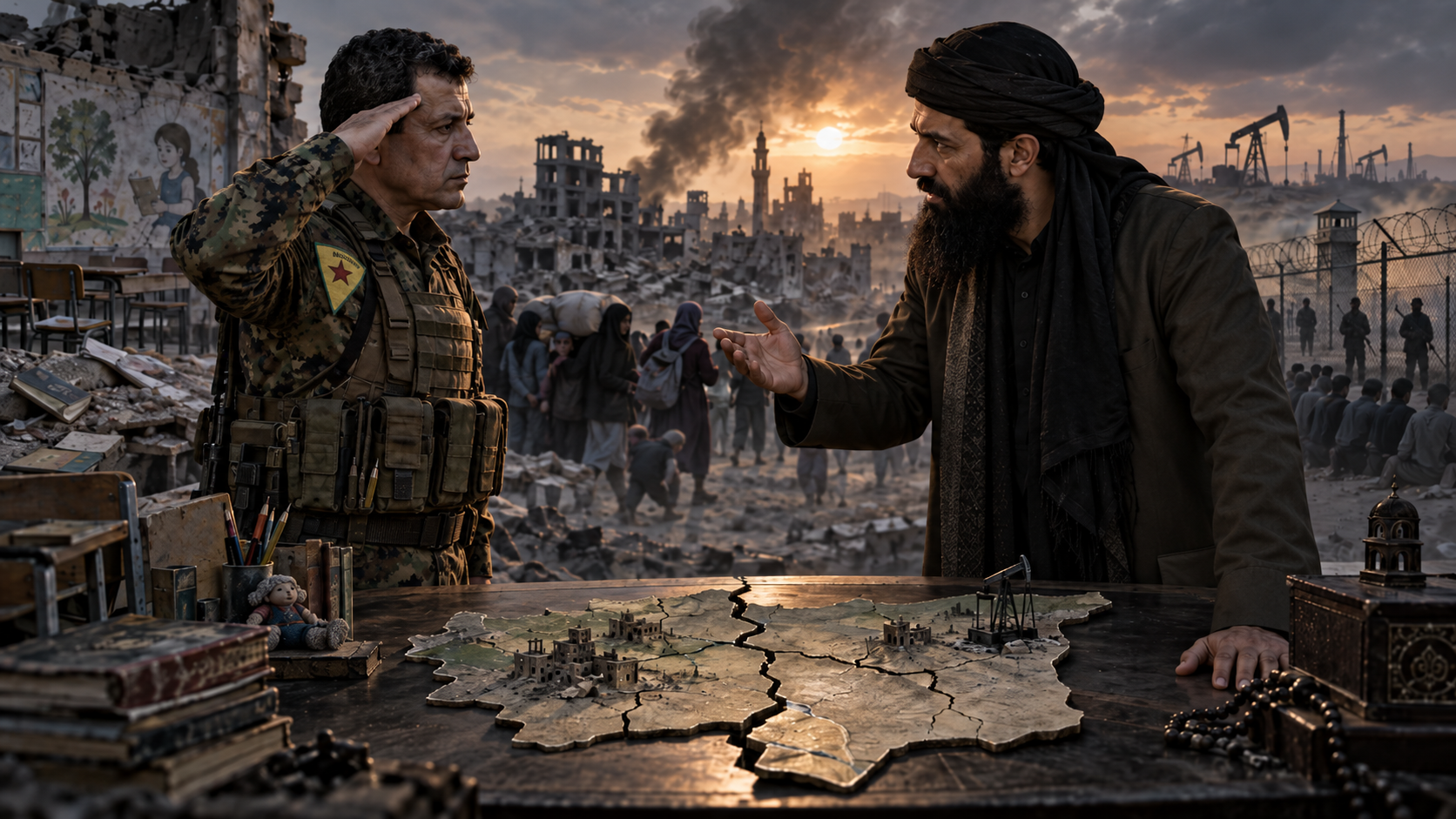
In recent days, SDF commander Mazlum Kobani dissolved his own army and was appointed as an adviser to Golani. To someone observing the issue from the outside, without knowing its background, this might create the impression that unity is finally being established in Syria and that everyone is getting along nicely. Unfortunately, that is not the reality.
The army known as the Syrian Democratic Forces was a highly capable military force, established with the support of the United States and the United Nations coalition forces, and composed predominantly of Kurds. It was created to fight ISIS. Many Kurds—my friends, people I knew and people I never knew—supported this struggle and gave their lives for it. They gave their lives first to liberate Kobani and then to clear every area of Syria where ISIS was present. Their deaths were therefore not meaningless. They died to protect Kurdistan and to defend Yazidis, Assyrians, Arabs, Turkmens and Kurds throughout Kurdistan.
And some of them are still missing, do you know that? Some of the young people who went to fight in Kobani and joined the SDF or the PKK remain missing because the reported death tolls never matched the number of people who disappeared. No one even knows where these people are. Kurdish people swallowed this and remained silent. Because they believed the SDF had liberated Kurdistan and Rojava, they stayed silent about everything the SDF did.
Then what happened?
ISIS was defeated, and after some time Rojava began managing Syria’s oil resources. It granted democratic rights to the people living there. On the one hand, it kept captured ISIS members under control in prisons; on the other, it established cooperatives, created democratic local administrations and brought the region into an organized system of governance.
Then suddenly Assad fled the country.
The SDF, with around 100,000 soldiers, did not move from its position. Damascus stood virtually empty, waiting for someone to take control of it. The soldiers of the regime had abandoned their weapons and Assad had fled to Russia by plane, yet the SDF—with its 100,000 Kurdish and Arab fighters—remained where it was.
Then Golani, an ISIS remnant and an Al-Qaeda dog who had controlled Idlib for some time, walked into Damascus freely, his dogs drooling over young women and children, and seized the city before declaring himself president.
What happened next?
He posed in mosques with the murderous agents of the murderous Turkish state. He massacred Kurds in Aleppo. And while Alawites were being massacred in Suwayda, Mazlum Kobani, leader of the 100,000-strong SDF, signed an agreement with Golani. On the very same day, at the very same hours that Golani’s dogs were massacring Alawites.
And even that was not enough.
For months they blockaded Kobani, leaving the people there hungry and thirsty. They handed over 60 percent of Rojava to Arab tribes and, at the same time, to Golani’s dogs, without firing a single bullet. Then, in exchange for appointing a single Kurd as governor of Hasakah, they swallowed everything and remained silent.
At the same time, Kurds all around the world were marching and rising up, while SDF leader Mazlum Kobani continued flirting with Golani.
Finally, they came up with the absurd idea of “integration” and sold out all the Kurds who had once united to clear Kurdistan of the remnants of ISIS—their losses, their lives and their children—to Golani, one of the founders of ISIS.
Every achievement that had been gained—education in the Kurdish language, road signs, books, schools, streets, everything and everywhere—suddenly began to be Arabized.
I have never forgotten it, and I never will.
The remnants of ISIS who entered every corner of Kobani performed prayers of thanksgiving in the squares of every place they entered. Meanwhile, Kurdish armies with weapons in their hands and at least 50,000 fighters did not fire a single bullet against this jihadist, murderous display.
General Mazlum even called on everyone to remain calm. He called on everyone to remain silent and surrender.
And everyone remained silent.
The entire world remained silent.
All Kurds remained silent.
Only the killers, and the Kurds who served them, spoke—to praise the killers and present them as innocent.
Now the enormous Kurdish armies, all those slogans about democracy, and Mr. Mazlum Abdi, who spent so much time playing at cooperativism, have ended with Mazlum becoming an adviser to the murderous Golani.
Ilham Ahmed became an appointed member of parliament before any election had even taken place in Syria. Someone else became an undersecretary, another became some other official.
In other words, all of them went and became civil servants of the remnants of ISIS—the very forces they had fought against years earlier and whose positions they had cleared with Kurdish blood.
To give an example from an anecdote told by my teacher İbrahim Halilbaran:
“In the past, Kurds described becoming an undersecretary as being the enemy’s dog. Now these people have decided that being dogs is good enough for themselves.”
And so the Kurds’ Democratic Army became ISIS’s Democratic Army.
In recent days, this democratic army has also taken ownership of a disgrace that ended with Kurdish youths setting themselves on fire.
While Golani’s dogs mercilessly slaughtered Kurds, Golani’s democrats remained silent. Yet when young people rose up against what was happening, they arrested them, silenced them, subjected them to violence and drove them to set themselves on fire.
And they were not ashamed.
Not even a little.
I suppose they are trying to make us ashamed, to humiliate Kurdishness and reduce us to a degraded nation. Otherwise, how could they commit such disgrace, such shame and such dishonour?
But we are Kurds descended from Ahmad Khani, Seyid Riza and Saladin.
We are not descended from the sell-outs who committed this disgrace.